
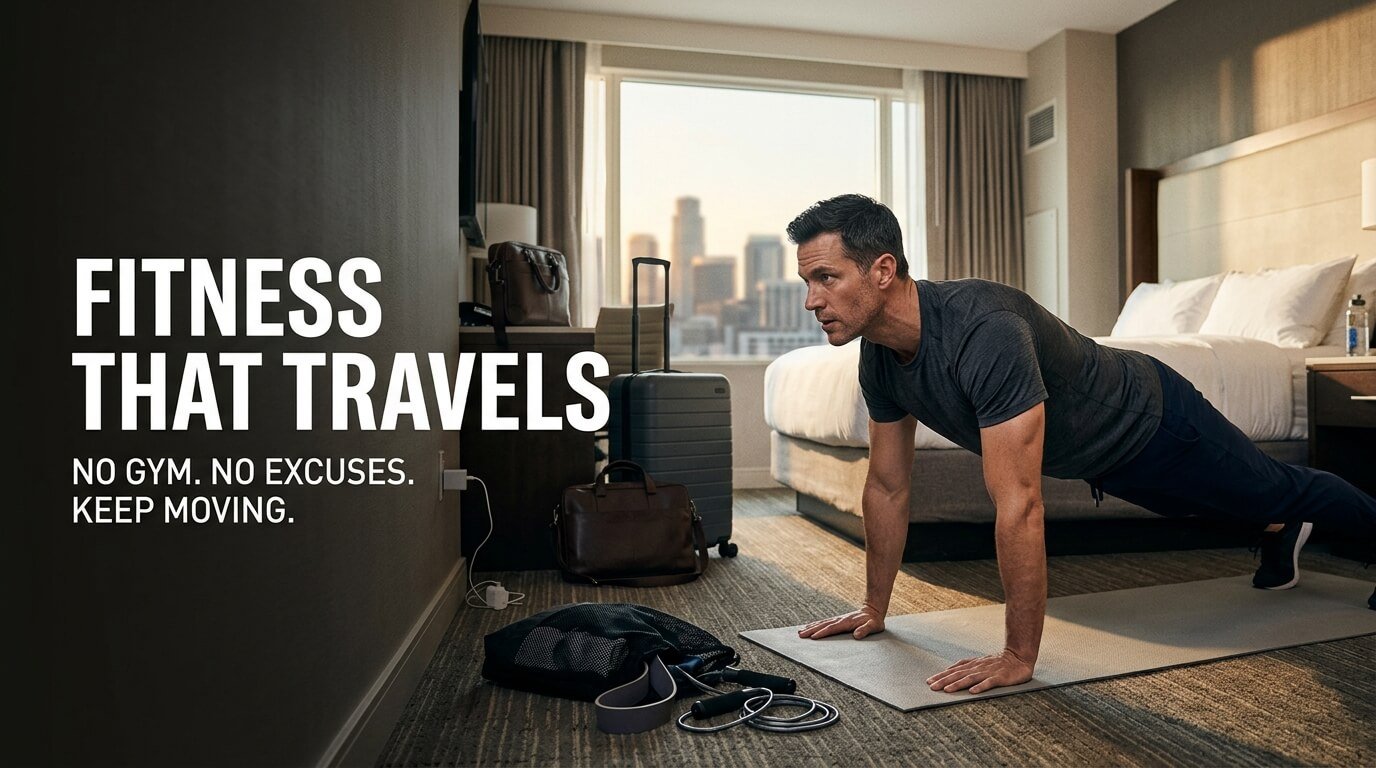
Building foolproof fitness habits for people who travel constantly for work sounds impossible when your calendar looks like a flight schedule. I know because I’ve lived it. Three years, over 200 hotel nights, and more time zones than I care to count. My fitness fell apart completely in year one. By year two, I’d cracked a system that actually stuck, even during back-to-back client trips. These are the habits that survived every delayed flight and sad hotel gym.
1. Pick a Workout That Needs Zero Equipment
The single best thing I did for my travel fitness was ditching gym dependency entirely. I built a bodyweight routine I could do in any hotel room, airport lounge, or even a parking lot once (long story).
My go-to is a simple circuit: push-ups, squats, lunges, planks, and burpees. Twenty minutes. That’s it. I follow a program on the Nike Training Club app because it adjusts to whatever time I have. When you stop needing a gym to work out, you stop having excuses. The floor is your gym. It’s always open, and the membership is free.

2. Schedule Workouts Like Meetings
Nobody skips a client meeting. So I started treating my workouts the same way. Every Sunday night, I look at my week, find the 20 to 30 minute windows, and block them on my calendar with actual alerts.
Usually it’s first thing in the morning before the day hijacks my plans. I’ve tried “I’ll squeeze it in later” probably a hundred times. It never works. The afternoon fills up, dinner runs long, and suddenly you’re in bed promising yourself tomorrow will be different. Morning blocks aren’t negotiable for me anymore. My team sees “Busy” on my calendar, and that’s enough.
3. Master the Hotel Room Warm-Up Ritual
Here’s something nobody talks about: the hardest part of working out on the road isn’t the workout itself. It’s starting. You’re tired, the bed is right there, and your body is confused about what time zone it’s in.
So I created a tiny warm-up ritual that tricks my brain into exercise mode. I put on my shoes, do ten jumping jacks, then ten arm circles. Takes about 90 seconds. By the end of it, my heart rate is slightly up and my brain has shifted from “maybe I’ll skip today” to “okay, I’m already moving.” Activation energy is the real barrier, not motivation. Lower the barrier and you win.
4. Pack a Travel Fitness Kit
I keep a small pouch in my carry-on that never gets unpacked between trips. Inside: a loop resistance band, a jump rope, and a lacrosse ball for rolling out tight spots. The whole thing weighs less than a pound.
The resistance band alone opens up dozens of exercises that bodyweight can’t fully cover, like banded pull-aparts for my shoulders after hunching over a laptop all day. I bought a set of Fit Simplify bands for about twelve bucks three years ago and I’m still using the same ones. Cheap, light, and they make a hotel room feel like a real training space.
5. Walk Aggressively
This sounds too simple to matter, but walking has been the most consistent form of exercise across all my trips. I walk to restaurants instead of taking cabs. I take calls while pacing the hotel hallway. I skip the shuttle at the airport and hoof it to the gate.
On a typical travel day, I rack up 10,000 to 15,000 steps without doing a single “workout.” I track everything on my Apple Watch, and honestly, the step count keeps me competitive with myself. Some days walking is all I get, and that’s perfectly fine. Movement is movement. The goal isn’t perfection, it’s consistency across chaotic weeks.

6. Foolproof Fitness Habits for People Who Travel Constantly Start With Nutrition
You can’t out-exercise a week of room service burgers and airport Cinnabons. Trust me, I’ve tried. My nutrition rules on the road are simple and I keep them loose enough to actually follow.
Rule one: protein at every meal. I order eggs at breakfast, grilled chicken at lunch, fish at dinner. Rule two: I carry protein bars in my bag for the moments between meals when I’d otherwise grab garbage. I like RXBAR because the ingredient list is short and I can buy them at almost any airport. Rule three: I allow myself one “whatever I want” meal per day. Restriction kills consistency. One good meal pattern repeated across a five-day trip does more than any strict diet I’ve ever attempted.
7. Sleep Like It’s Part of Your Training
Bad sleep wrecks everything. Your willpower drops, your cravings spike, and your body holds onto stress like a grudge. I used to treat sleep as whatever was left after work and socializing. Now I protect it.
I bring earplugs and a sleep mask on every trip, no exceptions. I set a hard rule: screens off 30 minutes before bed. And I keep my hotel room cold, around 66 to 68 degrees. The Manta Sleep Mask was a purchase I almost laughed at, but it genuinely changed how I sleep in unfamiliar rooms. When you sleep well on the road, morning workouts stop feeling like punishment. They actually feel possible.

8. Use the “Two-Day Rule” to Stay on Track
I stole this concept from Matt D’Avella and it’s the single most useful mental framework I’ve found. The rule is dead simple: never skip your workout two days in a row. One day off? Totally fine. Life happens. Flights get canceled. Dinners run until midnight.
But two days in a row? That’s where habits go to die. One skip becomes two, two becomes a week, and suddenly you haven’t exercised in a month. The two-day rule gives me permission to be human without letting the whole system collapse. It’s forgiving but firm, and it’s kept me more consistent than any 30-day challenge ever did.
9. Find Accountability That Travels With You
A gym buddy doesn’t work when you’re never in the same city twice. So I found accountability that follows me everywhere: a group text with two friends who also travel for work.
Every morning, whoever works out posts a quick photo or a screenshot of their workout app. No judgment, no long messages, just proof of life. Some weeks I post five times. Some weeks I post twice. But knowing that Ryan and Jess are going to see an empty thread from me on a Wednesday morning is enough to get me off the hotel bed. Digital accountability works if you pick people who actually care and won’t let you slide.
10. Track Progress With Photos, Not Just Numbers
The scale is useless when you travel. Water retention from flights, sodium-heavy restaurant meals, and inconsistent weigh-in times make the number meaningless. I stopped weighing myself on the road entirely.
Instead, I take a quick mirror photo every Monday morning, same pose, same angle. Over weeks and months, the visual progress tells a much more honest story than any number. I keep them in a locked album on my phone so nobody accidentally swipes into my shirtless progress pics during a work presentation. Small detail, but important. The photos keep me grounded when the day-to-day chaos makes it feel like nothing is working.
11. Embrace the “Good Enough” Workout
Perfectionism killed my fitness more times than laziness ever did. I used to think if I couldn’t do a full hour, it wasn’t worth starting. That mindset is poison when you travel.
Now my minimum viable workout is ten minutes. Ten minutes of push-ups and squats in a hotel room at 6 AM still counts. It keeps the habit alive. It maintains the neural pathway of “I am someone who exercises.” And honestly, some of my best workouts have started as “just ten minutes” and turned into 30 because once I started, I felt good. Lower the bar. Do the minimum. You’ll surprise yourself more often than not.
12. Reframe Travel as Training, Not an Obstacle
This mental shift changed everything for me. I stopped seeing travel as the thing that ruins my fitness and started seeing it as the environment that shapes it. Carrying luggage through airports is functional training. Walking through unfamiliar cities builds endurance. Adapting workouts to tiny spaces builds creativity and resilience.
The road warriors who stay fit long-term aren’t the ones with perfect conditions. They’re the ones who build foolproof fitness habits for people who travel constantly by working with the chaos instead of against it. Your routine will never look like an Instagram influencer’s morning. Good. It doesn’t need to. It just needs to be yours, repeatable, and real.
Frequently Asked Questions
How do I stay fit when I travel every week for work?
Focus on bodyweight workouts you can do anywhere, walk as much as possible, and protect your sleep. You don’t need a gym. A 20-minute hotel room circuit three to four times a week, combined with smart food choices and consistent step counts, will keep you in solid shape even during heavy travel months. Consistency beats intensity every time on the road.
What’s the best workout app for business travelers?
I’ve had the best results with Nike Training Club because it offers equipment-free workouts in varying lengths, including sessions under 15 minutes. Peloton’s app also works well if you prefer guided classes. Both let you filter by time and equipment, which is exactly what you need when you’re working out between meetings in a cramped hotel room.
Can I build foolproof fitness habits if my schedule changes every week?
Absolutely. The key is building habits around principles, not rigid schedules. Always work out in the morning, always walk instead of taking a cab, always carry a resistance band. These anchor habits adapt to any itinerary. The two-day rule helps too: never skip two consecutive days, and you’ll maintain momentum no matter how chaotic your calendar gets.
What should I eat to stay healthy while traveling for work?
Prioritize protein at every meal and carry portable snacks like protein bars or nuts. Choose grilled options over fried when eating out, and don’t restrict yourself completely. One flexible meal per day keeps you sane. Hydrate heavily, especially on flight days. Small, repeatable nutrition habits matter way more than trying to follow a strict meal plan from a hotel.
How do I stay motivated to exercise during long work trips?
Motivation fades, so build systems instead. Use calendar blocks, accountability partners, and the two-day rule. Track your progress with photos. Keep your travel fitness kit packed and ready. When you remove friction and lower the barrier to starting, you rely less on motivation and more on momentum. That’s what separates people who stay fit on the road from those who don’t.
Conclusion
Staying fit while living out of a suitcase isn’t about willpower or having the perfect setup. It’s about building small, repeatable habits that survive canceled flights, late dinners, and questionable hotel gyms. Pick three or four of these strategies, test them on your next trip, and keep what sticks. What’s the one habit that’s been hardest for you to maintain on the road?