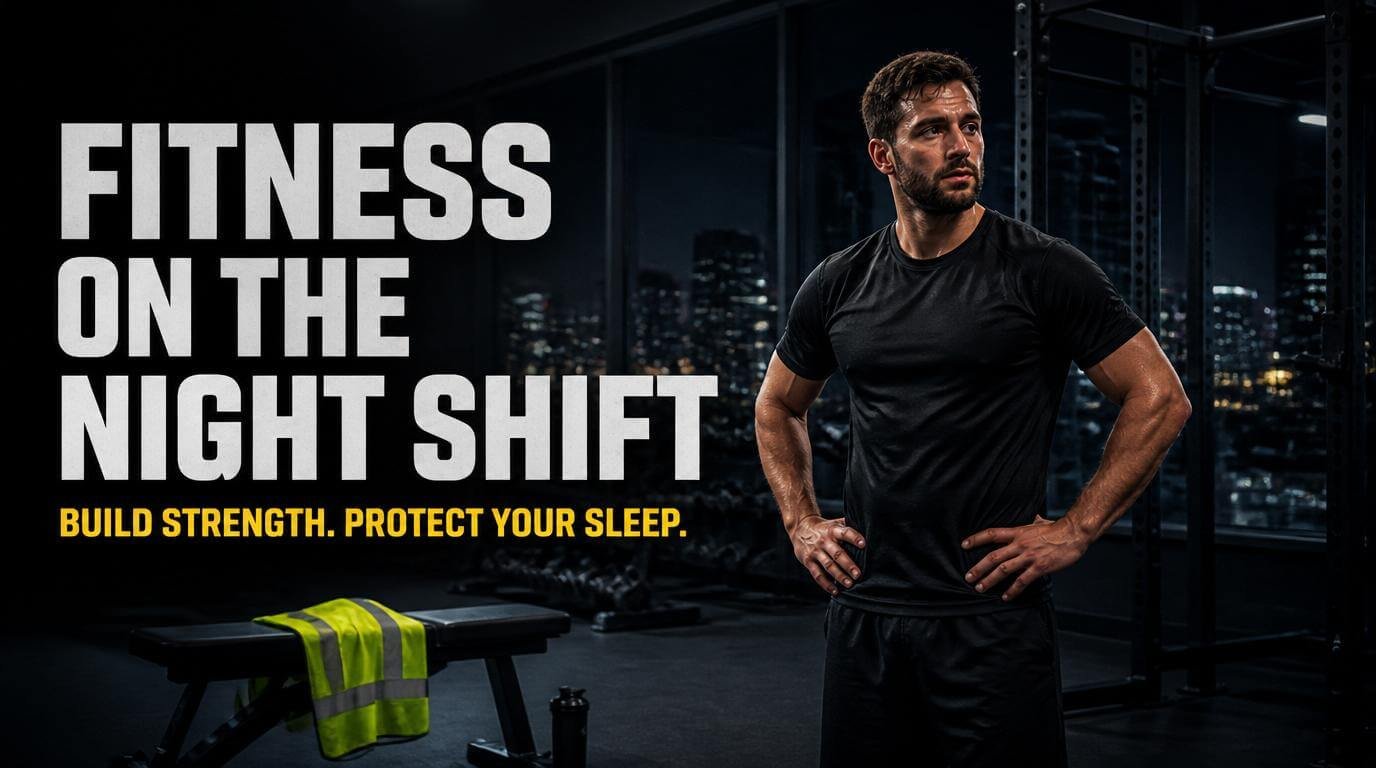
Finding fitness routines for people who work night shifts regularly feels like solving a puzzle where half the pieces are missing. Your body wants sleep when everyone else is at the gym. Your meals happen at 2 a.m. Your “morning” starts when the sun sets. I worked 11 p.m. to 7 a.m. for three years at a distribution warehouse, and I gained 30 pounds before I figured any of this out. The advice below comes from real trial and error, not textbook theory.
Why Standard Fitness Advice Falls Apart on Night Shifts
Most workout programs assume you wake up at 6 or 7 a.m., eat three meals during daylight hours, and sleep when it gets dark. That framework collapses when your schedule is flipped. I tried following a popular morning lifting program during my first year on nights. I’d get off work at 7 a.m., force myself to the gym, and push through squats while my eyes burned from exhaustion. Within two weeks, I tweaked my lower back because my coordination was garbage from sleep deprivation.
The problem isn’t willpower. It’s biology. Your circadian rhythm controls hormone release, body temperature, and muscle recovery. When you fight it instead of working with it, you get injured, burned out, or both. The first real breakthrough for me was accepting that I needed a completely different approach, not a modified version of what daytime people do.
Figure Out Your Personal Energy Window
Before you pick any program, spend one full work week tracking when you actually feel alert and strong. For me, that window was roughly 7 p.m. to 9 p.m., right before my shift started. Some of my coworkers felt best right after sleeping, around 4 or 5 p.m. One guy swore by training at 8 a.m. right after clocking out, though that never worked for me personally.
Grab your phone and set hourly reminders. Rate your energy from 1 to 10 each time it buzzes. After five to seven days, a clear pattern will show up. That pattern is your training window, and building your fitness routine around it is the single most important decision you’ll make. Everything else, exercise selection, volume, intensity, all of it flows from this one thing.

Fitness Routines for People Who Work Night Shifts: The Framework That Worked
Here’s the structure I landed on after months of tweaking. It’s built for someone working four to five night shifts per week with two or three days off.
Training Days (3 Per Week)
I trained three days a week using a full-body approach. Splitting muscle groups into a five-day “bro split” never made sense because my recovery was already compromised from irregular sleep. Full-body sessions meant each muscle got hit frequently but with lower volume per session, so I wasn’t wrecked for my next shift.
A typical session looked like this:
- Barbell squat or leg press: 3 sets of 8
- Dumbbell bench press or push-ups: 3 sets of 10
- Cable row or dumbbell row: 3 sets of 10
- Overhead press: 2 sets of 10
- A core movement like dead bugs or pallof presses: 2 sets of 12
Total gym time was 35 to 45 minutes. I trained at a 24-hour Planet Fitness, which was practically empty at 7 p.m. No waiting for equipment, no small talk, just work.
Off Days
On rest days, I did 20 to 30 minutes of walking. Not because some influencer told me to hit 10,000 steps, but because sitting in a warehouse all night made my hips and lower back feel like concrete. Walking loosened things up and helped me fall asleep faster when I got home.
Nail Your Pre-Workout Meal Timing
Eating too close to a workout made me sluggish. Eating too early left me running on fumes. The sweet spot was a real meal about 90 minutes before training. Nothing fancy. I’m talking rice and chicken, a couple of eggs with toast, or oatmeal with protein powder mixed in.
I avoided pre-workout supplements with heavy stimulants because I still needed to regulate my sleep after my shift ended. If I took 300mg of caffeine at 7 p.m., I’d be staring at my ceiling at 9 a.m. when I desperately needed to be unconscious. A small coffee or half a scoop of something mild like Legion Pulse (the lower-caffeine version) was my ceiling. Your sleep quality directly affects your gains, and night shift workers are already fighting an uphill battle on that front.
Protect Your Sleep Like It’s Sacred
You can have the best fitness routine on the planet, but if your sleep is trash, your results will be too. I learned this the hard way. During my first year, I averaged maybe five hours of broken sleep. My lifts stalled, I felt inflamed constantly, and I caught every cold that went around the warehouse.
What changed things for me:
- Blackout curtains from Amazon (the Nicetown brand, specifically, they block every bit of light)
- A white noise machine running nonstop
- Keeping my bedroom at 66 to 68 degrees
- Putting my phone on Do Not Disturb with only emergency contacts allowed through
- Wearing blue-light blocking glasses during the last two hours of my shift
I started averaging six and a half to seven hours of solid sleep. Within three weeks, my energy in the gym jumped noticeably. My squat went up 15 pounds in a month after being stuck for ages. Sleep is the most underrated part of any fitness routine, and it matters even more when your schedule fights your biology.

Handle Your Nutrition Without Overcomplicating It
Night shift eating gets weird fast. Vending machines become your pantry. The break room always has donuts somebody brought in. At 3 a.m., your body craves sugar and carbs because your cortisol is doing strange things it wouldn’t do during the day.
I stopped trying to follow elaborate meal prep plans designed for 9-to-5 people. Instead, I simplified everything. I prepped the same four meals in bulk on my days off: ground turkey with rice, chicken thighs with sweet potatoes, Greek yogurt parfaits, and overnight oats. I packed two meals and two snacks for each shift. The snacks were usually almonds, protein bars (I liked the RXBAR ones because they didn’t taste like chemicals), or string cheese with an apple.
The key was having food ready so I never had to make a decision at 3 a.m. when my judgment was at its worst. Decision fatigue is real, and at three in the morning, a bag of Doritos will win against a balanced meal every single time unless the balanced meal is already sitting in your cooler bag.

Adjust on Your Days Off Without Going Crazy
Here’s where a lot of night shift workers mess up their fitness routines. On days off, you try to flip back to a “normal” schedule to spend time with family or handle errands. That flip destroys your consistency.
I eventually compromised. On my first day off, I’d sleep in until about noon and stay up until midnight. On my second day off, I’d push my bedtime to 2 or 3 a.m. to start easing back toward my work schedule. I trained on one of those off days, usually the first one, when I felt the most rested.
The worst thing you can do is stay up for 20 plus hours trying to force a normal schedule. I did that for months, and every Monday felt like starting over from scratch. A partial flip, where you stay somewhat nocturnal even on days off, keeps your body from constantly playing catch-up.
Track Progress Differently Than Daytime Lifters
Progress on a night shift schedule is slower. Accept that now and save yourself frustration. Your recovery is compromised, your hormones are slightly off, and your stress levels are probably higher than someone who sleeps when humans are supposed to sleep. I stopped comparing myself to friends who trained five days a week on normal schedules.
Instead, I tracked two things: consistency and trend lines. Did I hit three sessions this week? Good. Is my squat higher this month than last month, even by five pounds? Great. I used the Strong app to log every workout and looked at monthly trends rather than weekly ones. Small, steady progress over six months added up to real results. I put on visible muscle and dropped my body fat noticeably during my second year on nights, all while training less frequently than I had in my twenties on a day schedule.
Know When to Skip a Workout
This might be the most important section here. Night shift work taxes your nervous system in ways that regular schedules don’t. Some days, you will feel absolutely demolished. Maybe you only slept three hours because a neighbor decided to mow their lawn at 11 a.m. Maybe your shift ran long, or the workload was brutal.
On those days, skip the gym. Go for a walk if you feel up to it, or just rest. One missed session means nothing over a six-month timeline. Forcing a heavy squat session on three hours of sleep is how you herniate a disc or drop a barbell on your chest. I know because I almost did exactly that during month four. The spotter at the gym saved me from a very bad bench press rep, and I never trained on severe sleep deprivation again.
Listen to your body. Night shift workers have less margin for error, so respect it.
FAQs
What’s the best time to work out if you work the night shift?
The best time is whenever your energy peaks, and that varies by person. Most night shift workers I’ve talked to prefer training before their shift starts, usually late afternoon or early evening. I trained around 7:30 p.m. and it worked perfectly. Spend a week tracking your energy levels hourly to find your personal sweet spot.
Can you build muscle while working nights?
Absolutely, but it takes more intentionality around sleep and nutrition. Your recovery is slower because disrupted circadian rhythms affect growth hormone and testosterone output slightly. Prioritize consistent sleep, enough protein (I aimed for around 0.8 grams per pound of body weight), and progressive overload. Results come, just expect them on a slightly longer timeline.
How many days per week should night shift workers exercise?
Three days of resistance training per week is a solid target for most night shift workers. That gives you enough stimulus to build strength and muscle without crushing your already-taxed recovery capacity. Add light walking on off days if you can. Trying to train five or six days a week on a night schedule usually leads to burnout within a month or two.
Are fitness routines for people who work night shifts different from regular routines?
The exercises themselves don’t need to change dramatically. Squats, presses, rows, and core work are still effective regardless of when you do them. What changes is the scheduling, meal timing, recovery strategies, and expectations around progress. The structure around the workouts matters more than the workouts themselves when your sleep schedule is inverted.
Should I use pre-workout supplements on the night shift?
Be careful with stimulants. High-caffeine pre-workouts can wreck your ability to fall asleep after your shift ends, which undermines everything else. If you train before your shift, a mild caffeine boost is usually fine since you’ll be awake for hours anyway. If you train after your shift, skip the stims entirely and rely on good nutrition and a proper warm-up for energy.
Conclusion
Building a fitness routine around night shift work is absolutely doable, but it requires you to throw out most conventional advice and build a system that fits your actual life. The biggest wins come from respecting your sleep, finding your energy window, and staying consistent without beating yourself up over slower progress. What’s your shift schedule like, and when do you find your best training window?